The decisions
behind the website.
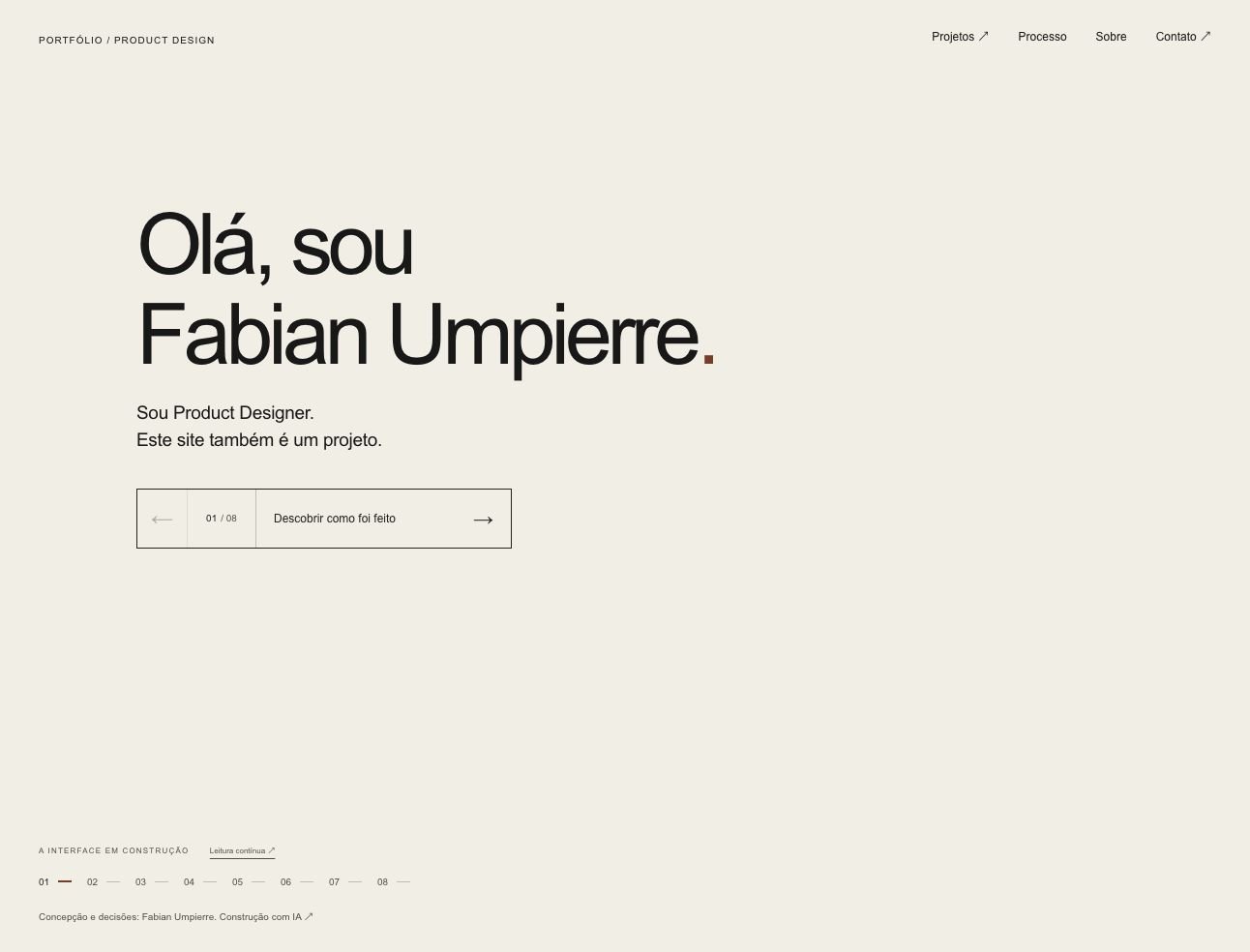
Hi, I'm Fabian Umpierre.
I'm a Product Designer. This website is a project too.
You probably want to see my portfolio before hearing this story.
I thought you might. So I created two paths.
Every project starts with a problem.
In this case, I wanted to show how I work without wasting your time.
My process needs context. Your time calls for a short path. Rather than forcing both into one sequence, I offered direct access to the work and an optional journey through the decisions.
I didn't have all the answers.
Actually, we rarely do.
Who will visit this website?
- What we know
- Recruiters, design managers and peers are the audiences defined in the brief.
- What I researched
- Research describes different needs among people reviewing a portfolio.
- Still a hypothesis
- These audiences may prefer different levels of detail. I haven't observed visitors here yet to confirm this with data.
- What changed in the interface
- The work and the narrative have separate entry points from the start.
References: Nielsen Norman Group
What are they looking for?
- What we know
- The available content covers the context, my role and my professional work.
- What I researched
- The references I consulted recommend showing both the work and the thinking behind it, including my individual contribution.
- Still a hypothesis
- Brief context and optional detail may make this portfolio easier to review.
- What changed in the interface
- The portfolio has its own pages; the making of this website follows a separate path.
References: Nielsen Norman Group · Interaction Design Foundation
How much time will they have?
- What we know
- I haven't measured how much time visitors spend here yet.
- What I researched
- Content should be easy to scan and free of unnecessary detail.
- Still a hypothesis
- Some visits may be brief. That informs a choice, not a statistic.
- What changed in the interface
- You don't have to finish this story to see the work.
References: Nielsen Norman Group
How can I show experience without seeming stuck in the past?
- What we know
- Years of connecting design, technology, strategy and people through successive changes in the digital world.
- What I researched
- Research highlights the importance of communicating skills, ways of thinking, decisions and outcomes, alongside completed projects.
- Still a hypothesis
- A portfolio built around skills, experience and learning may communicate my seniority better than a conventional sequence of case studies.
- What changed in the interface
- The portfolio becomes more than a project showcase: a narrative about experience, working across disciplines, strategic thinking, adaptability, autonomy and curiosity.
References: Nielsen Norman Group · Interaction Design Foundation
How much of the process is worth showing?
- What we know
- When I reviewed the first prototype, I found the structure too conventional.
- What I researched
- The references recommend showing the process. They don't validate this particular experience.
- Still a hypothesis
- Small demonstrations may communicate my decisions better than lengthy explanations.
- What changed in the interface
- In this iteration, you experience the consequences before opening the details.
References: Nielsen Norman Group · Interaction Design Foundation · Camara UX
My first idea didn't work.
Well, it worked. But it wasn't what I wanted.
The first prototype was editorial and vertical. In my assessment, the content worked, but the experience didn't yet demonstrate the self-referential concept clearly enough.
See the actual records +
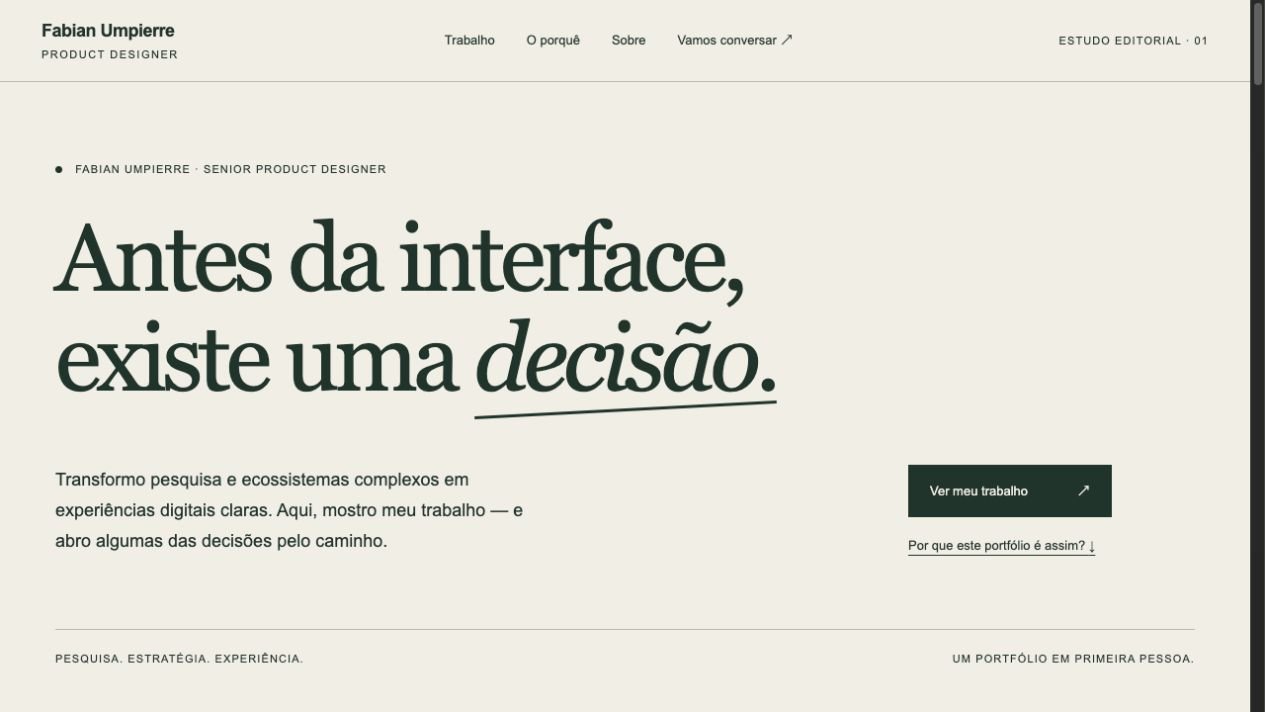
The problem wasn't the content. It was the way of telling the story.
“The design process is a straight line.”
That would be nice. But the path can include research, design, testing, mistakes, revision and more research. Design Thinking taught me to appreciate the curves, detours and discoveries that only happen when we leave the straight line behind.
Sometimes moving forward means going back.
I could put an animation here.
The interactive demonstration scales, rotates and moves an element, then restores it. No new information is added.
But why? Not every technical possibility needs to become a feature.
I didn't build this website alone.
Come to think of it, I've rarely built anything alone.
Implementation was AI-assisted through vibe coding. I defined the problem, intent and criteria, reviewed the result and requested adjustments.
My request
“an editorial prototype of the website and the first chapter of the narrative”
Translated excerpt from the actual request that led to the first prototype.The AI's output
The first proposal had structured content, vertical sections and an editorial narrative.
An actual screenshot appears in the chapter about my first idea.My assessment
It worked, but the self-referential idea wasn't coming through. The experience still felt conventional.
A summary of my own feedback.A new direction
I asked for progressive states, elements that change function and an interface that demonstrates its decisions.
This direction came from reviewing the prototype, not from visitor testing. Everything can still change.The refined result
The AI did a good job implementing the state-based journey. I then refined the navigation, sequence, colours and content as I tried it out.
This version is still being evaluated.
Even this typeface was a decision.
You can try some of these choices right here in the interface.
The serif typeface comes from the first editorial study; sans serif is the current choice. The palettes already appear along the journey. The new spacing densities are experiments from this iteration.
The system foundations were built collaboratively: I direct and review; AI helps organise tokens, explore variations and implement components.
The technology supporting the experience +
I chose Next.js and React as the foundation of this website. They support the experience by organising pages, reusing components and connecting narrative states. With AI, I turned this direction into a working structure and reviewed what it produced.
- Next.js + React
- Dedicated case-study pages and components shared with the narrative.
- Native motion
- Position and scale transitions using the browser API. Content remains available with reduced motion.
- Separate content
- Project stories live in their own files, independently of the experimental presentation.
The interface changes. The criteria remain.
Technology changed. Many times. So did I.
I've worked in digital design since 1999. I've seen technologies emerge, dominate the market and disappear. I've had to learn, unlearn and start over more than once.
I'm a Senior Product Designer working across strategy, research and delivery.
I focus on structuring products as functional systems: understanding behaviour, rules and flows before moving to the interface. I combine research, modelling and prototyping to explore solutions and reduce uncertainty.
In recent years, I've brought code-based prototyping and AI into my process to explore hypotheses and support decisions. Facilitation, design thinking and my training at Kaospilot also shape how I collaborate with product, technology and business teams.
Explore my skills
Product strategy and judgement
Product strategy, planning and requirements gathering. Systems thinking and data-informed decisions that balance people, business and technical feasibility.
Research and design
User research, usability testing, UX/UI, interaction design and information architecture. Prototyping, including high-fidelity work, and design systems. Hands-on exploration of complex problems and the judgement to know when to go deeper or simplify.
Collaboration and leadership
Facilitation, discovery and mentoring. Communication, interpersonal skills, emotional intelligence, accountability and adaptability to align teams and stakeholders.
Tools and building
Figma, FigJam, Miro and analytics platforms. Code-based prototyping and AI-assisted workflows.
1999 · the beginning
Interface & Web Design
Responsibilities and skills
- Interface and web design for digital projects.
2004–2010
Project Manager
Responsibilities and skills
- Coordinating multidisciplinary teams.
- Establishing information architecture processes.
- Keeping strategy and delivery aligned.
2010–2018
Head of Planning
Responsibilities and skills
- Technical leadership of digital strategy initiatives.
- Facilitating workshops and discovery.
- User-centred projects and team mentoring.
2019–present
Senior Product Designer / Experience Strategy
Responsibilities and skills
- Qualitative and quantitative research.
- Architecture and flows for complex projects.
- Prototyping and validation with users.
- Translating business needs into product decisions and analytical reports.
Now · this project
Authorship and direction of this portfolio
Responsibilities and skills
- Defining the problem, intent and criteria.
- Reviewing prototypes and refining the experience.
- AI-assisted implementation and collaboratively developed visual foundations.
Done. I've finished my portfolio.
Well… I prepared a version. At this point in the story, launch was still ahead and the prototype was under review.
Editorial prototype ·
The homepage and first chapter in a vertical structure.
Why: Give the two-path hypothesis an initial, navigable form.
Record: DEC-002 + screenshot of the first prototypeState-based interface ·
The name became a signature; navigation began demonstrating two paths.
Why: My review suggested that describing the process alone didn't communicate the idea.
Record: DEC-003Navigation, colour and experience ·
Closer controls, colours for each state and research connected to experience.
Why: Shorten the distance to the next action and put the references in context.
Record: DEC-004 + later adjustments recorded in the conversationAuthorship and collaboration ·
AI, vibe coding, technology and the foundations of the system became part of the journey.
Why: I wanted to make collaboration and responsibility for decisions visible.
Record: DEC-005Iteration 03 · under review ·
Comparisons of actual versions and experiments with paths, motion and visual language.
Why: Replace some explanations with consequences you can experience.
Record: DEC-006
Journal entries, not published releases or Git commits. Design doesn't end at delivery. It continues when we start learning from the result.
Get in touch